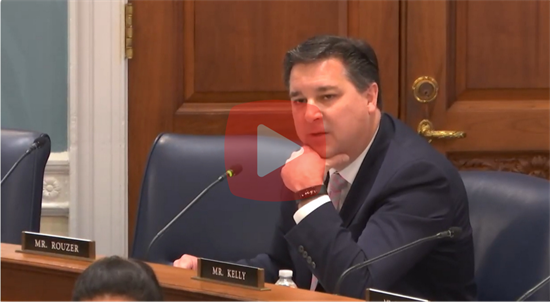
This past week, I was back in Washington advocating on your behalf. At an Agriculture Committee hearing, I brought up for discussion with the Chairman of the Commodity Futures Trading Commission (CFTC) the ongoing supply chain constraints driving up the cost of fertilizer.
On the House Floor, I voted to cut red tape to help streamline projects and drive down costs faster. I celebrated the return of the Artemis II crew and penned an op-ed on public transit safety. Read more about all of this and more below!
If you received this newsletter from a friend, and you would like to continue receiving these updates, you can subscribe here or connect with me on Twitter, Facebook, and Instagram.
Fertilizer Prices
This past week, the House Committee on Agriculture held a hearing with Commodity Futures Trading Commission (CFTC) Chairman Michael S. Selig to discuss issues the Commission is addressing. As the agency responsible for overseeing commodities trading, the CFTC must ensure our markets are not being manipulated by foreign traders. This is particularly important for the current fertilizer market.
Much of the world’s fertilizer supply travels through the Strait of Hormuz, and obvious challenges in the region have created a supply chain crunch for growers here in the U.S. As farmers start planting their 2026 crop, they need certain inputs for their respective crops, particularly fertilizer. To protect our domestic supply and ensure North Carolina’s farmers are able to access fertilizer for the year, I emphasized the importance of making sure adversarial foreign actors or traders do not exploit market volatility to drive up prices.
As a globally traded commodity, foreign markets may seek to buy up our fertilizer supply to either sell in other countries or hold out for higher prices. The CFTC has the unique role of monitoring these markets to ensure they are not being manipulated. This is particularly important for North Carolina agriculture where a large majority of farmers have yet to buy all the fertilizer needed for their crops.
I know that Chairman Selig will continue to work towards ensuring our growers have access to the necessary inputs to produce the safest and most abundant food supply in the world. You can watch the remarks at the hearing here.
Cutting through Red Tape
This past week on the House Floor, I supported three bills focused on cutting bureaucratic red tape and strengthening American competitiveness.
The RED Tape Act ends a burdensome review process which requires the Environmental Protection Agency (EPA) to weigh in multiple times on proposed manufacturing projects — both as part of other agency reviews and then again on their own. By eliminating redundant permitting requirements, the RED Tape Act will allow faster expansion of American manufacturing and help lower costs for the consumer.
The FENCES Act and FIRE Act both address how states and businesses are penalized for pollution they did not create. Currently, pollution from foreign countries, such as Chinese smog or Canadian wildfires, can be counted against American manufacturers, stopping the development of new projects, and hurting our domestic manufacturers. This just drives up costs.
Together, these measures aim to promote growth, protect American industry, and drive down costs by making the government work more efficiently for us all.
Safety on Public Transit
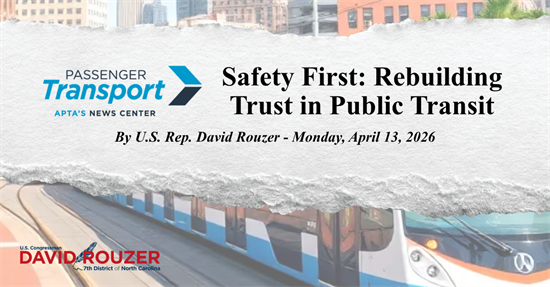
Safety on public transit is more important than ever. Everyone deserves to reach their destination safely and efficiently. As Chairman of the House Subcommittee on Highways and Transit, I recently wrote an op-ed for APTA's Passenger Transport Magazine, "Safety First: Rebuilding Trust in Public Transit," about the importance of safe, reliable transit systems across the country. A small excerpt below:
“Unfortunately, safety aboard public transit has hit very close to home. My state tragically lost a life when Iryna Zarutska was brutally murdered this past August on Charlotte light rail. This tragedy should be a wake-up call for every transit agency and policymaker in the country. The traveling public deserves better, and so do the men and women who work around the clock to get riders safely to their destinations. We cannot normalize violence on transit systems, and we cannot accept a system where riders feel abandoned the moment they step onto a platform."
On Wednesday, April 1, 2026, the Artemis II mission carried American astronauts farther into space than any crew has traveled in more than 50 years.
Among the crew was NC State alum Christina Koch, whose dedication, skill, and pioneering spirit exemplify the very best of the Wolfpack. This historic 10-day mission carried the crew on a journey around the Moon before returning to Earth, making Koch the first woman to fly to the Moon. Her role in this mission is a source of pride and inspiration for many, including me!
Opportunities for High School Students
High school students in NC-07 are invited to participate in this year’s Congressional Art Competition, a nationwide program sponsored annually by members of the U.S. House of Representatives since 1982.
The winning artwork will be displayed for one year at the U.S. Capitol with the artist invited to Washington to attend a national reception honoring student artists. Students interested in participating must submit their artwork and signed release forms in person to one of my district offices by 5:00 PM on Friday, April 24, 2026. For more information, please visit my website.
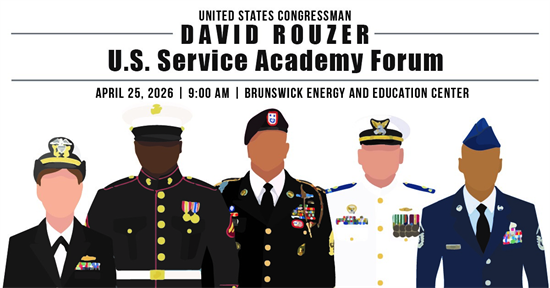
On April 25, students, parents, and educators in NC-07 are invited to engage directly with my staff and representatives from all five service academies, including the U.S. Coast Guard Academy. This forum provides a vital introduction for those looking to navigate the unique nomination and admissions processes of these prestigious institutions.
The event will be held at Brunswick Energy and Education Center in Southport at 9:00 AM ET. Interested participants must RSVP via email to Lisa.Littler@mail.house.gov. For more information on the event or the nomination process, please visit my website.
Good News Story
After Hurricane Matthew (2016) and Hurricane Florence (2018) severely damaged his family home, Darrick Virgil of Robeson County looked to rebuild his existing home. The road was not easy. Darrick encountered several roadblocks along the way dealing with government red tape and technicalities. But on April 8th, thanks in part to the support of Brightspeed, which donated land needed to complete the build, Darrick received the keys to his new home. To read more about this story of perseverance and how neighbors help neighbors, visit WRAL News.
Unfortunately, Darrick’s story is not unique. Total mismanagement at the state level left many in our communities waiting years for assistance, even when funding was available from the federal government. While ReBuild NC has completed more than 4,140 homes, 105 other homes are still waiting to be finished. It is simply unacceptable that nearly a decade after these storms, this is still the case. I have continued to voice my concerns about this privately and publicly. When tragedies brought on by severe weather occur, the government should be working for us — not against us.
Closing Thoughts...
"What we don't need is more spending, and what we don't need are taxes, and what we do need is a lot less of both." – Ronald Reagan